

Produced-sand management
Sep-iSYS™ Desander
For wells where produced sand constrains choke opening, erodes equipment or fills downstream vessels.
At a glance
Sand out first, proven offshore.
Overview
Sand out first, at line pressure.
- What it does
- A surface skid that removes produced sand from the full wellstream at line pressure. It protects downstream chokes, valves, vessels, piping and rotating equipment.
- Current offer
- Field proven, installed offshore Malaysia. Offered today, backed by NGLTech’s sand-test work and project-specific engineering.
- Intellectual property
- Jointly developed and owned with PETRONAS.
- Deployment routes
- Package supply, or call-off inspection and maintenance support.
How it works
On your wellhead platform: sand out first, at line pressure.
Produced sand holds a well back: it constrains choke opening, erodes equipment and fills downstream vessels. The Sep-iSYS™ Desander sits in the flowline and removes produced sand from the full wellstream at line pressure, before it reaches the choke, the first bend and the separator. Fines pass.
01
Install
The skid is moved into the wellbay and the flowline is routed through it.
02
Produce
Sand out first, at line pressure: the choke, the first bend and the separator see a desanded wellstream.
03
Flush
Collected sand is flushed to the sand bin while the desander stays online.
04
Dispose
The sand bin goes for disposal. If there is no disposal route, there is no project.
An illustration of how the unit is used on a wellhead platform, not a project design.
On a field
See it working on a platform.
The interactive field scene needs JavaScript. The How it works section above explains each step.
Illustration only: not a real field, not to scale, no units on screen.
At your site
What it needs on your platform, and what it protects.
On your platform
- Space in the wellbay, in the flowline ahead of the choke
- A sand-disposal route
- Power and instrument air where purge is automated
What it protects
- Downstream chokes and valves
- Vessels and piping
- Rotating equipment
Applications and enquiry data
Where it is used, and what to send.
Applications
- Sand-producing or choked-back wells
- Restarts and post-workover flow
- Upstream of rotating equipment
- Separator protection
- Compact wellhead platforms
- Installed-unit inspection and reinstatement
Data for an enquiry
- Particle-size distribution: d10, d50, d90
- Sand production rate
- Gas, oil and water rates
- Pressure, temperature and fluid properties
- Allowable pressure drop and design class
- Space and sand-disposal route
Is it a fit?
Where the Sep-iSYS™ Desander does its best work.
Sand is holding the well back.
Produced sand that constrains choke opening, erodes equipment or fills vessels is removed from the full wellstream at line pressure.
Equipment downstream needs protecting.
It protects downstream chokes, valves, vessels, piping and rotating equipment.
The sand size is known, or can be tested.
Particle-size distribution is the sizing gate. If you do not have it, we can test for it.
The sand has a route out.
If there is no disposal route, there is no project. The sand-wash system is the answer where overboard disposal is permitted.
Good to know
Particle-size distribution is the sizing gate.
Without a d50 and d90 no one can honestly size a desander or promise an efficiency, ours or anyone else’s. If you do not have it, we can test for it.
The cut size is set per duty.
Fines pass. The particle-size distribution sets the cut size the desander has to reach, and the basis is stated per duty.
It protects the separator.
It is a solids technology, not a separation train. It protects a separator; it does not replace one.
Surface desanding manages a sand rate.
Surface desanding manages a rate; it does not contain a formation failure.
Sour service is assessed to ISO 15156.
Sour and corrosive service changes the metallurgy and the cost. Assessed to ISO 15156 against your actual fluid; we do not publish a threshold.
Results from the sand test rig validated the technology before it was installed offshore.
Field and development record
Field proven offshore Malaysia, built on sand-test work and joint development.
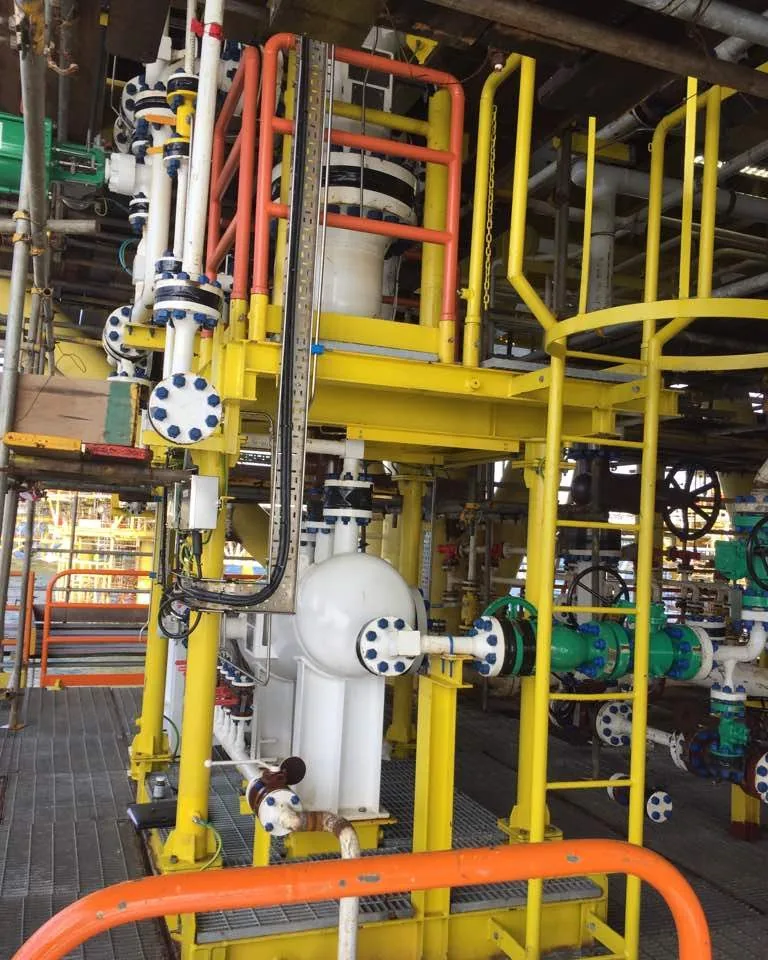
The Sep-iSYS™ Desander is field proven, installed offshore Malaysia. Supplied from September 2017. The sand test rig NGLTech commissioned in 2015 at Technology Park Rawang supported development of the cyclonic sand-removal approach. The Sep-iSYS™ Desander intellectual property is jointly owned with PETRONAS.
- Jointly developed and owned with PETRONAS
- 2014 to 2017: 900# Sep-iSYS™ inlet package for PETRONAS Floating LNG 2
- 2015: sand test rig commissioned
- Field proven, installed offshore Malaysia
In the field
Our work, in pictures.
10 images. Select an image to see it larger.
Other technologies
One portfolio, different constraints.


Next step
Is sand holding your well back?
Send the particle-size distribution, the sand rate and the flow conditions. If you have no PSD, we can test for it.